It was not how I wanted to spend the first day in the Boundary Waters, being completely underwater.
Frankly, I was nervous when we pulled up to Moose Lake. I wasn’t nervous about the trip. I was worried about my skills. I’m a clumsy person and routinely make mistakes when learning something new. Trial and error is fine when juggling butter knives. But what do you do in the Boundary Waters when there’s a mishap with no urgent care? This was on my mind as I started to unload the camping gear. Questions started to bubble, but I had to keep it together. Worry would only tempt fate. Already, I rammed my head into the open hatch of the minivan. The pain was beyond piercing, but I didn’t pass out. Instead, I pressed on and helped load the gear into the water taxi.
The reason we were using a specially fitted boat to transport our canoes and gear was due to our location. Dave thought it best not to spend a whole day canoeing to the campsite. Instead, we cut the commute in half by taking a motor boat through the expanse of Moose Lake. From there we began our journey, canoeing through the lakes of Newfoundland, Sucker, Birch, and Carp. And once we reached the thin wisp of Seed, we were only one lake away from our destination.
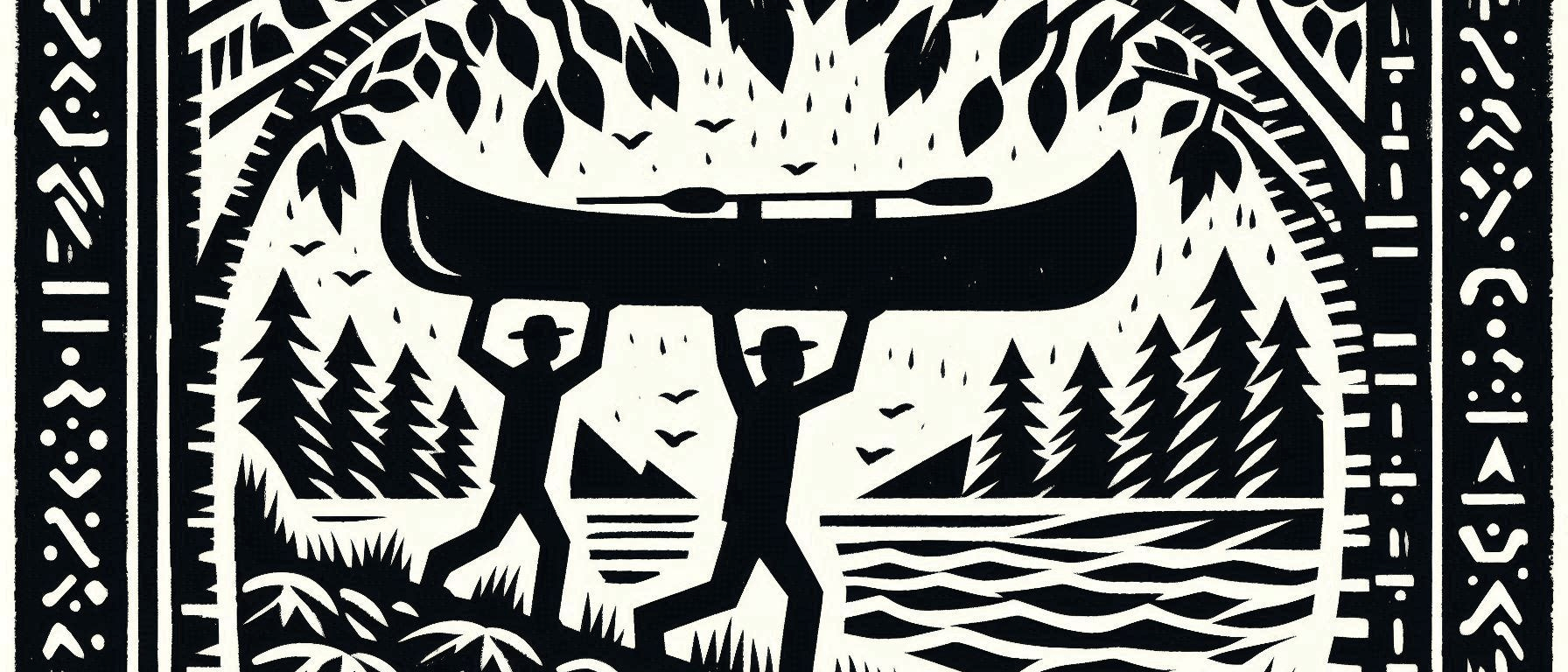
Even with the water taxi, the journey was still a journey, for not only did we have to canoe through multiple lakes, we also had to carry our gear over the portions of land that separated them. The French word for this form of travel is portage.
When North America was unlimited in natural resources, there were hearty, stout men who portaged beaver pelts, mink furs and Gucci handbags from the Northwoods to the shores of Lake Superior. They worked from sunup to sundown, slept under starry skies and carried the equivalent of two Romanian gymnasts on their backs. They were called Voyageurs and their lives weren’t glamorous. It wasn’t uncommon for them to tip canoes in rough waters and perish. They succumbed to disease and suffered injuries, the most common – hernia. But still they hunted and trapped and traversed land to reach Grand Portage, “The Great Carrying Place” is what the Native Americans called this portion of Pigeon Falls that had to be circumvented before reaching Lake Superior. “The Great Paycheck” is what the Voyageurs called their final destination for they would spend a few weeks on the North Shore, trading and gambling, resting and drinking before returning to the Northwoods before the first snow.
With the warm sun on my shoulders and a spring to my step, I enjoyed carrying the non-equivalent of a Romanian gymnast from lake to lake. I fell into a routine as earlier worries began to ebb. After all, It was a beautiful day and I was surrounded by unspoiled scenery.
With a million acres of natural wilderness, The Boundary Waters is like no other place in the world. It’s a transitional area where the Boreal Forest, with its pines, spruce and firs, intermingle with the deciduous birch, aspen, ash and maples. Trees were everywhere, but what caught my attention were the enormous rocks that jutted from every part of the shore. Granite, basalt, greenstone, exposed bedrock lay everywhere like an exposed skeleton of the earth’s core.
“What’s with all the rocks,” I asked.
Don said that’s what happens to a region after an ice age. For two million years massive sheets of ice scoured this region, shearing off layers upon layers of topsoil, pushing the sediment south. That is why Iowa is known as America’s Farmland and Minnesota is the land of ten thousand melted glaciers.
When we reached the far end of Carp Lake, Dave thought we could take a small creek that ran parallel with the trail. Chad and I were game, but Don and John wanted to stick with the trail. So Chad and I followed Dave in his single canoe, lolling up the lazy stream until it became too shallow. So we got out and pulled the canoes, carefully negotiating around exposed boulders for we were pulling two beauties.
One day Dave woke up and said, “I think I’ll build some canoes.” And with the help of a video, some books and the internet, he spent a summer fashioning a two-person and one-person canoe, canoes that turned heads and received many compliments, canoes that shimmered and cut through the calm, blue water.
Dave kept a casual pace while Chad and I followed. The journey reminded me of the times Chad and I were kids exploring the falls of the Big Sioux River and the Indian Trails at Terrace Park. It felt good to be young. It felt good to be wading through warm water with the sun on my back. It felt good to play the role of a Voyageur with a couple of Duluth Packs, some fishing poles and my brother as a companion as the warm water gently rose to my knees.

Chad and I got back in the canoe and continued to paddle upstream. Then we reached a section of rapids caused by a beaver dam.
I thought our foray had come to an end, but Dave kept paddling towards the dam, negotiating his canoe, studying the rapids, scanning the dam, then steadily moving to the left where a few boulders acted as stepping stones to where he could ease out of his canoe and use the stones like a set of stairs to pull the canoe over the wooden obstacle.
He made it look so easy like walking a dog in a park.
“Ready,” Chad asked.
I nodded.
When we reached the dam, I found it difficult to steady the canoe against the swirling water. Still I told Chad I was going to make my move. I lifted my leg, set my foot on the outside of the canoe and just like that! I disappeared from the scene.
At the moment my mistake wasn’t apparent. But on reflection I didn’t follow Dave’s lead. Not exactly. We both took the same route. We both reached the same spot. But where Dave got out of the left side of his canoe, I exited to the right, and that’s why I was underwater with a torrent of water above me.
Eventually, I resurfaced to laughter. Chad’s. But his glee turned to panic when I grabbed the canoe.
His brother falling into the creek was hilarious. His brother rocking the canoe and sending him and all the gear downstream would be a tragedy.
“Don’t tip the canoe,” he screamed.
“I won’t,” I gurgled.
Chad thought I was panicking. I wasn’t. I’m not a person who panics. I’m a person who accidentally falls out of canoes. And as I pushed the front end of the canoe to the boulder staircase, I knew the moment would live beyond the present tense. At any get-togethers when the moment would present itself, Chad would tell the tale of what can happen when rock, water and elevation meet…
I thought I found a trail that wouldn’t kill us. The day before Vu, Quynh and I tried our luck at Cascade River State Park on the North Shore where two very different adjectives meet: beautiful and rugged.
I brought along a book that highlighted the hikes of the region. There was a seven mile hike that led to Hidden Falls, but it would take four hours and rise and fall some six hundred feet. It also had a trail rating of DIFFICULT, which is an adjective you should avoid while on vacation. So I asked the park ranger if there was anything easier, and she suggested the much shorter Mountain Lookout Trail, which offered a nice view of the park’s valley.
The North Shore – starting from Duluth and extending to the Canadian border – is not like any part of the world for it was formed years ago by a seismic ongoing volcano that poured lava in descending layers to Lake Superior. The Cascade River meets this volcanic step ladder five miles inland with the last three miles descending some 900 feet, which is fun if you are free flowing mountain water, but not so great if you are a middle-aged office worker hiking in the other direction. It is estimated that 15,000 feet of lava was deposited in this park and it felt like we were climbing over all of it.
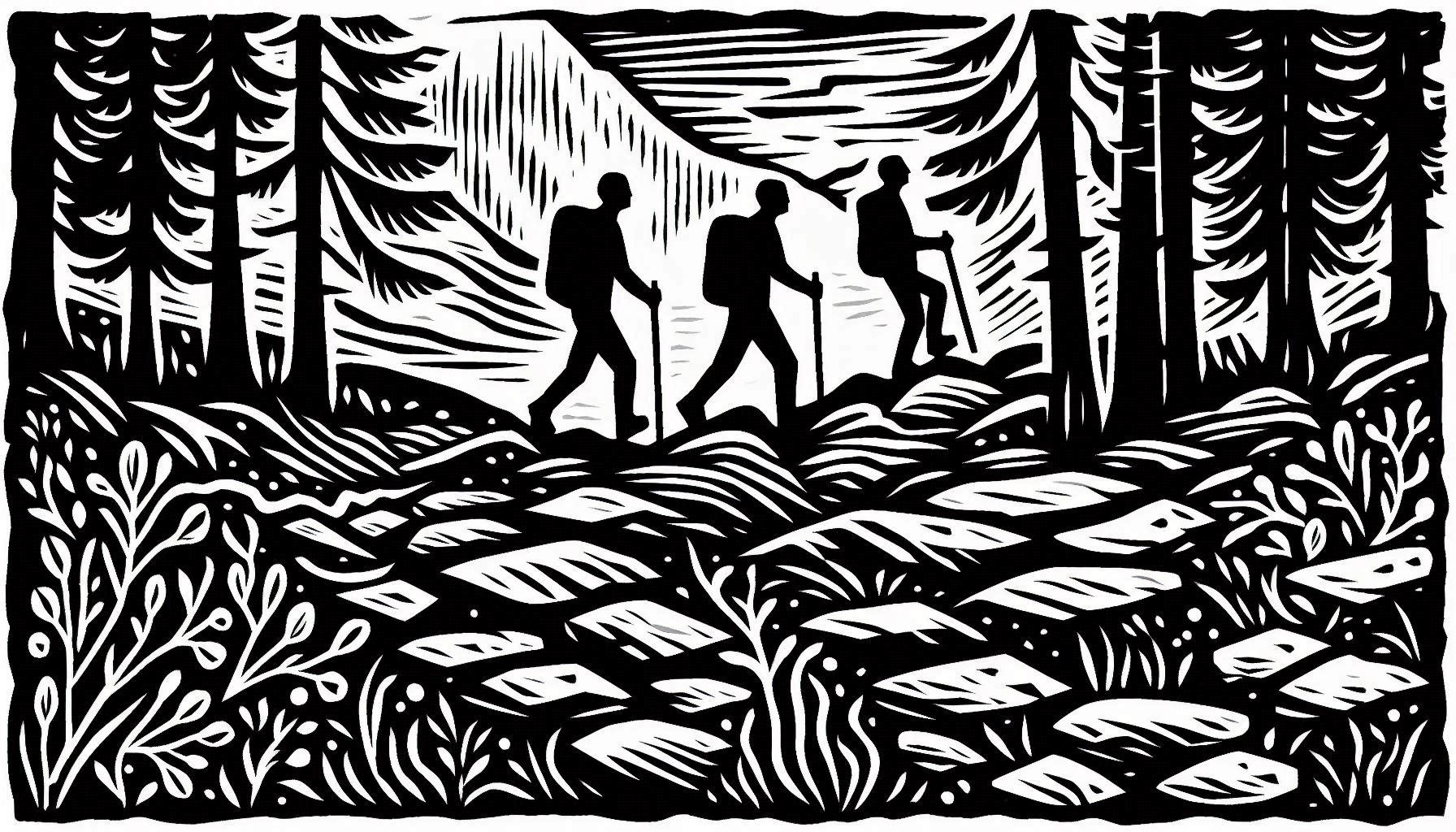
Luckily, we survived the hike, but none of us wanted a repeat. So, while I rested my feet at a Grand Marias motel, I leafed through my stupid hiking book to find one rated SUBURBAN MALL EASY. The book had a lot of information but it wasn’t going to grant my wish. So we picked our poison and drove to an area which looked familiar because I had been on the same road the week before on my way to Moose Lake.
“All right, are you up for some hiking?” I asked the group when we reached Blackstone Secret Ennis Lakes Trail.
There was no response. But still we headed down the path, which immediately turned on us. The trail was rated MODERATE, but required our full attention as every step was littered with wet rocks and damp stones like Mother Nature forgot to pick up her kid’s toys.
“This trail is NASTY,” said Vu.
“This is MODERATE,” asked Quynh.
It was hard to disagree. I thought it was only a matter of time before I tumbled off the path, but it was Vu who took a dive, slipping on a rock and twisting his ankle. On the ground he officially changed our hike to Slippery Rock Trail. Still he continued and we reached our destination: a cliff that overlooked Ennis Lake.
My book showed an icon of a climber scaling the cliff. There was also an icon of a swimmer in the lake and behind the swimmer was an icon of a fish. The two icons were the same size and it looked like the fish was about to eat the swimmer.
I scanned the lake and did not see such a scenario. In fact, everything about the moment was uneventful. But was I really looking? All I really knew: we were the backyard of a world renowned photographer.
Jim Brandenburg is the wildlife photographer. His photos have graced the covers of many National Geographic issues. For one assignment he spent ninety days in his Northwoods home with the goal of capturing a subject with just one photograph.
One day. One photo. No retakes.
Chased by the Light was the result, and National Geographic was so impressed with the collection it offered Brandenburg the largest spread ever given to a single photographer.
Perusing the pages, I kept wondering how he captured such delicate moments with only one snap of the shutter. I usually click fifty photos before giving up. But Brandenburg not only captured something unique, he captured the soulful essence of a region. Among the pictures:
- peeling white bark from a pink birch
- frosty shards of ice on a frozen wild flower
- a red maple leaf floating in a brooding pond
- a half-frozen pupil of a recently deceased deer
The photographs in Brandenburg’s collection reveal a forest alive in its final season, but nothing appeared with such intensity as we stood on a cliff overlooking Ennis Lake.
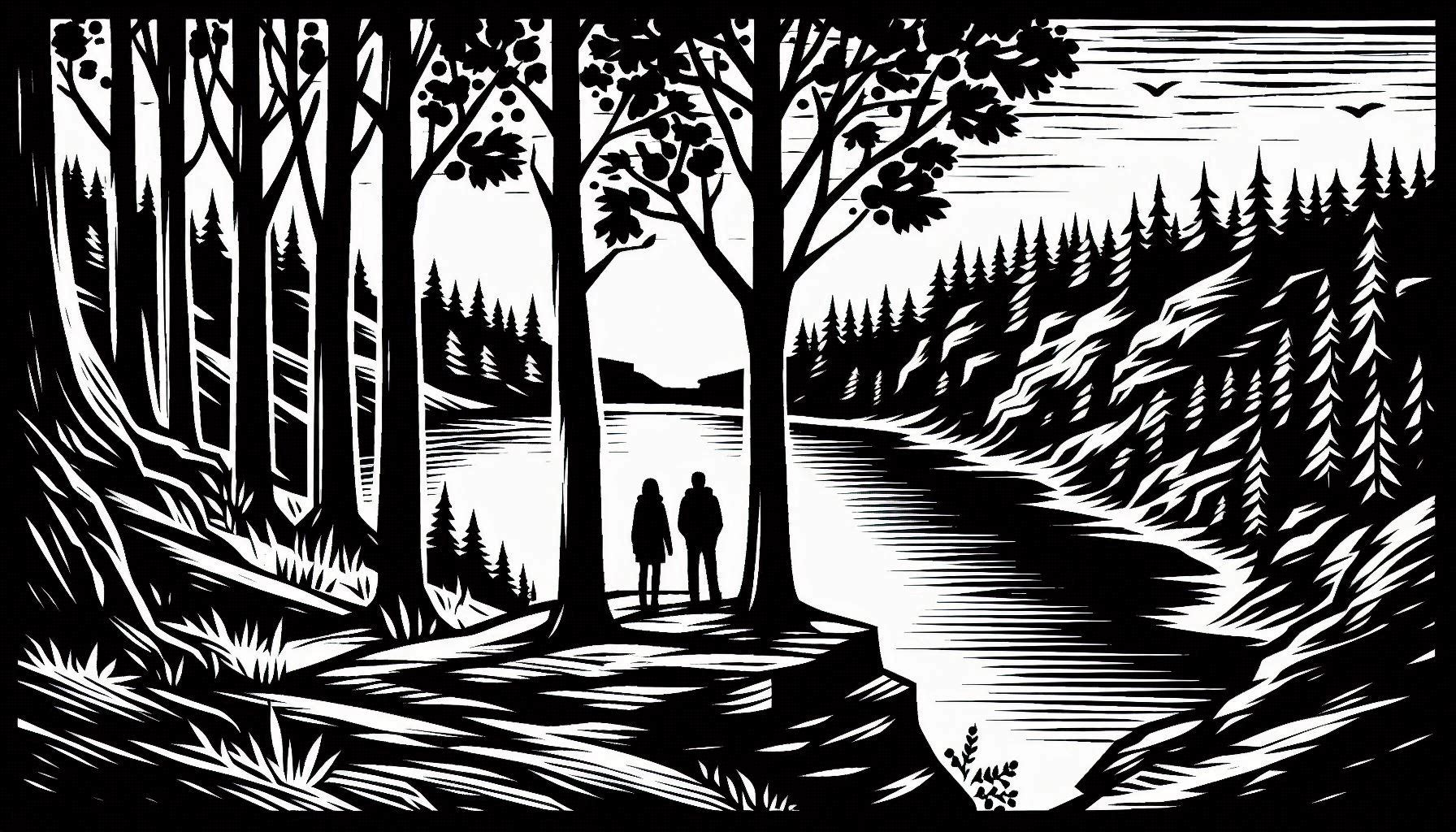
Vu and I sat on a boulder. Quynh headed back to the trail to do some more exploring. Vu took a few pictures of the lake. I leafed through my stupid hiking book. We rested and waited for a moment to remember, but nothing was going to happen. So we headed back to the main trail.
When we reached the fork, Quynh was nowhere to be found.
It was easy to lose touch with someone in the middle of a forest. But how do you lose contact with someone in the middle of a lake?
 fornaught.net