
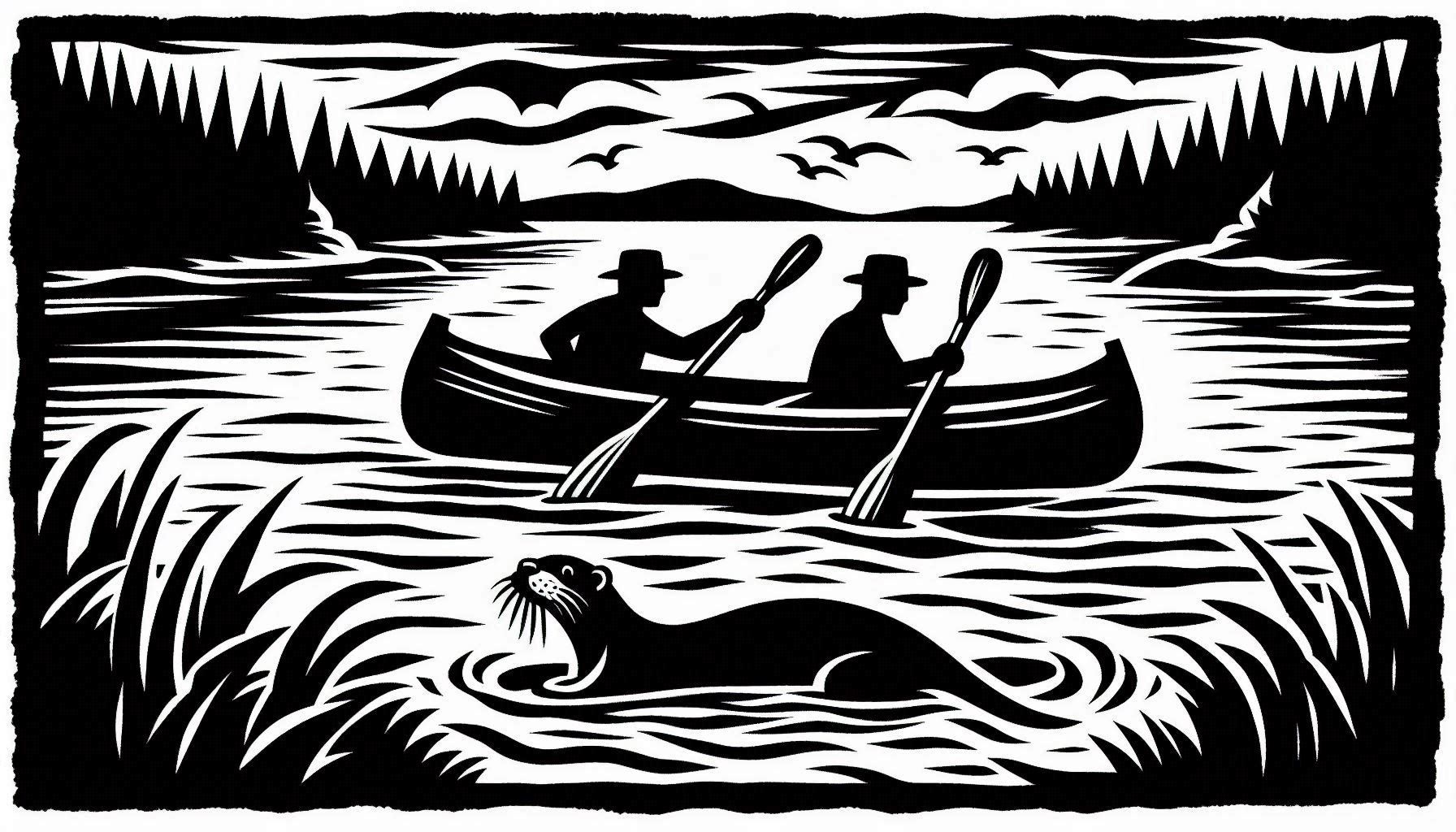
After John caught a few more fish, we headed back to the camp. Knife Lake was as calm as an untouched glass of water, and yet, I saw ripples, something gliding below the surface. Chad and I stopped paddling. And as I reached for my camera, two furry torpedoes appeared.
With short ears, compact necks and powerful legs, North American River Otters are built for the water, but what propels them is their dorsoventral undulating tails. If beavers are the sedans of the Boundary Waters, otters are the sports cars.
As soon as I tried to take their picture, the otters started to beep at me, then disappeared.
Don pulled alongside our canoe and we waited.
The otters popped up behind us.
By the time we turned our canoes, they had re-submerged.
We waited. Water gently lapped against our canoes.
The otters popped up, but further in the distance.
Chad and I put our paddles in the water.
“What are you doing,” Don asked.
“Trying to get a picture.”
“Good luck,” he said as he headed back to the campsite.
Although we were in a streamlined canoe, it may as well have been an ocean liner. Still we tried to follow as the otters started to swim along the rocky shore.
At first the otters were annoyed by our presence, but by the time we rounded a small peninsula, they became irate. This wasn’t a meet and greet with a sharing of fish tales. This was a wildlife encounter and the otters did not have to behave like they were in a petting zoo. They were heading somewhere and they did not want to be followed. So they popped up to yell at us.
I didn’t speak fluent otter, but it sure sounded like they were saying “Get lost” and “Go back to Fargo.” Even stranger…
“Well, hello!”
I swung my head for I was caught off guard. Earlier in the evening I had a double-shot of espresso, a countermeasure to keep me awake on my second night in Vegas. Not only did the coffee do the job, it was fueling me into the next day. So I tried to burn off the excess by walking The Strip.
On my first visit to Las Vegas The Strip was the place to be with its sweaty masses dipping into The Stardust, The Sands, The Riviera and The Flamingo. It was a time when casinos were more like corner grocery stores instead of behemoth super structures that took up block after block.
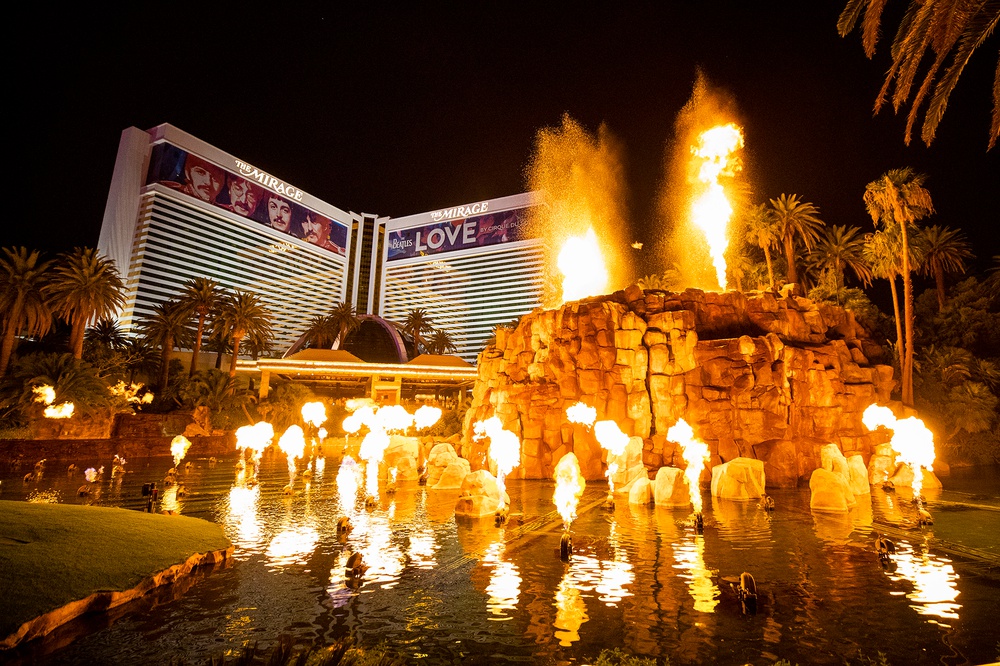
It was Steven Wynn who changed everything. At one time Las Vegas was the only place to gamble. But slowly, a wide array of reservations and municipalities saw the lure of the gambling dollar. Pretty soon gambling came to Massena as well as Biloxi. If Las Vegas wanted to survive, it needed something more. So Steven Wynn not only built The Mirage Hotel and Casino, he also erected a volcano.
From there the arms race began.
I reached the corner of Las Vegas and Flamingo and looked around. I wanted to cross the boulevard to visit the hotels with the two greatest modes of Italian transportation: the gondolas at The Venetian and the Lamborghini dealership at The Palazzo. But what I thought would be a simple jaunt turned perilous. Chest-high concrete barriers kept me from entering the street. Even if I jumped the embankment, I still would have to run across eight lanes of traffic. (Not good odds.) So I continued down the boulevard, looking for a more pedestrian friendly crossing. But when I reached Spring Mountain Road, I realized my best chance of crossing was at the beginning. I could see The Venetian and the Palazzo, but they were unreachable. Off in the distance were Steven’s latest creations, Wynn and Encore, encased in cobalt-blue, looking like a pair of sleek cigarette lighters shimmering in the cool night, the pinnacle of one man’s dreams and possibly the bookends of another boom and bust.
I looked around, but there was nothing left to see. So I headed back.
What was a quiet walk soon turned eerie. Had Vegas closed for the evening? How could I be outlasting Sin City?
Then, the greeting.
I snapped my head to see a young woman behind me. She was wearing tight jeans, a silk blouse and sipping an energy drink through a straw.
I always prided myself on my senses, but this young lady snuck up on me.
“Where did you come from?”
“It’s not where I came from, but where we are going.”
“And where are we going?”
“Back to your place!”
Even though an encounter like this on The Strip is not uncommon, I was still unnerved.
“Seriously, were you hiding behind a palm tree?”
“What does it matter?”
What did it matter other than she could have conked me on the head and relieved me of my empty wallet.
As we kept walking, my nerves started to ebb.
“Well, what do you think,” she asked.
Well I thought of Ron who was probably sleeping.
“I don’t think my friend would appreciate me bringing back a party.”
“Where are you staying?”
“The Bellagio.”
“Oh, the Bellagio,” she said with an air of disdain.
Then more walking.
“We could go back to my room,” she added.
“Where are you staying?”
“Mandalay Bay.”
“Oh, Mandalay Bay.”
I held no opinion of the hotel.
“What’s your name,” I asked.
“Naudi.”
I was hoping for Denise.
“What’s your name,” she asked.
“Steve.” At least I didn’t add Wynn.
She smiled. “I don’t believe you.”
Well, I didn’t believe her fake stripper name.
When we reached the Mirage, Naudi stopped.
“So,” she asked, looking dewy-eyed.
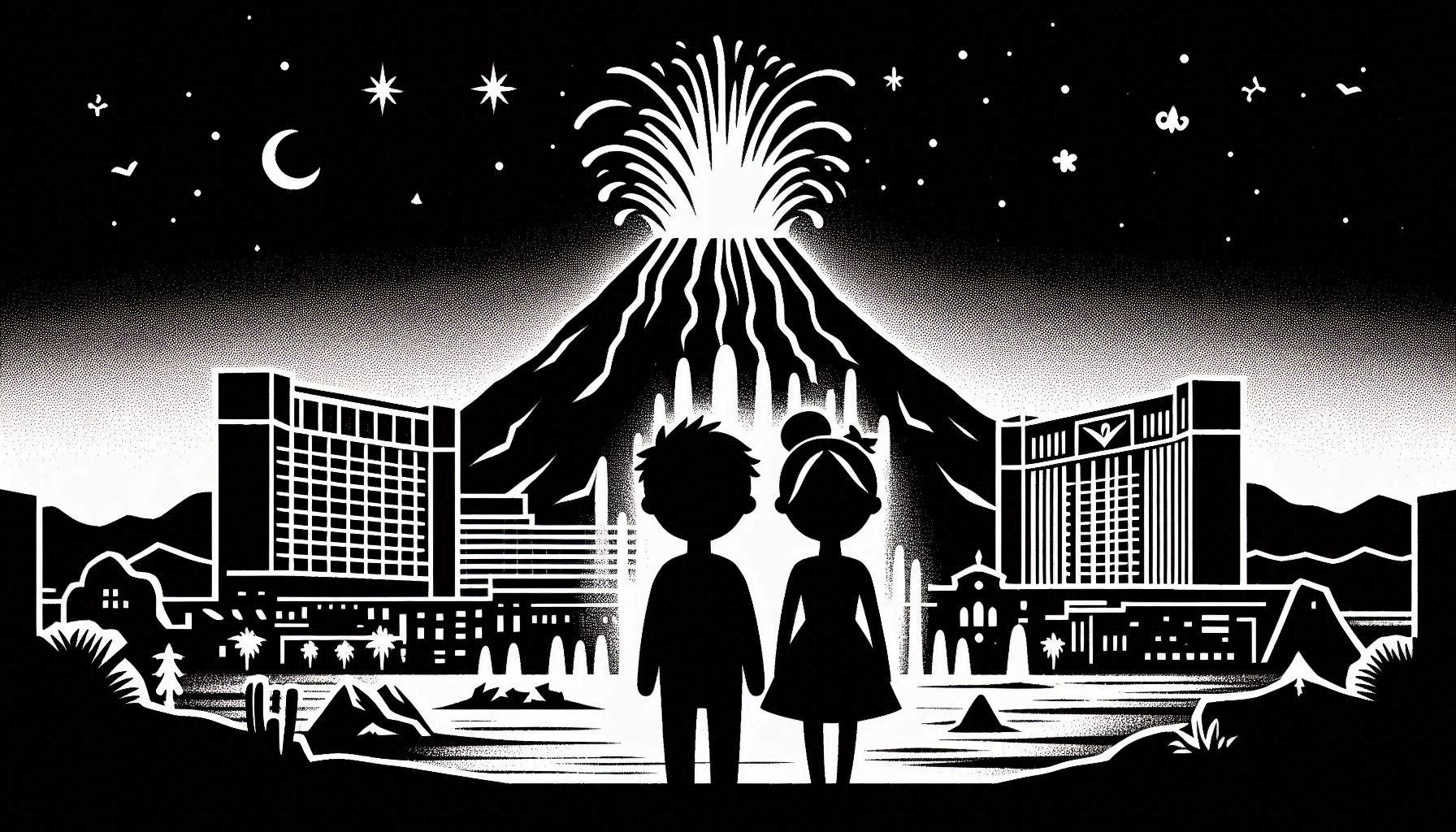
Sometimes I wish I could be more carefree and impulsive, but those traits were never a part of me. Also, you don’t have to tug much to reveal the dark edges of Las Vegas.
Naudi shrugged and headed to the Mirage. Then, the quiet returned. It was so quiet I could hear off in the distance the thick boom of…
“BAAAAAUUUUUUUUUUMMM!!!”
Earlier, Vu, Quynh and I visited Duluth. We ventured along the iconic pier, browsed the T-shirt shops, boutiques and other curios. And as the sun set, we had dinner on a rooftop patio.
As a cool breeze soothed my sunburned face, I couldn’t help notice the low-key atmosphere of our dining experience. For a Friday night it was quiet. Where were the college students? Where were the tourists? Did the economic downturn of Las Vegas reach this Lake Superior town?
As the restaurant started to close, we headed to the car.
Vu has one golden rule that he has followed since I’ve known him: never pay for parking. To Vu walking an extra mile is not a problem if he can avoid plugging a parking meter. So we parked in an adjacent neighborhood separated from the downtown by the Aerial Lift Bridge.
At 386 feet long and 227 feet high, the Aerial Lift Bridge would be like any other except for the fact that it lifts like a garage door to accommodate the boats and ships coming in and out of the harbor.
When it was built in 1905 the bridge had a rarer design – a gondola. Hanging from 300 foot wire cables, an open steel cage moved from shore to shore ferrying wagons, pedestrians and those fancy new automobiles. But as the years rolled on, the gondola could not keep pace with the booming activity. By the roaring 20’s nobody had time for a swinging bridge. As far as Duluth was concerned gondolas were for canals of Venice and the future Vegas casinos. Duluth was a modern city in need of a modern bridge. So in 1929 it was modified to its current design.
Although the Aerial Lift Bridge doesn’t have nearly the traffic it once did, it still is a popular tourist destination. It was voted number one out of two attractions to see in Duluth by 10best.com. It had a 70% favorable rating on the architectural website glasssteelandstone.com. And the most important stat of all was an inspection done in March 2009:
- DECK = 6 out of 9
- SUPER STRUCUTRE = 5 out of 9
- SUB STRUCTURE = 7 out of 9
- SUFFICIENCY = 49.5 out of 100
I’m not sure if 49.5 is a great rating. I do know that if the bridge was in high school it would be headed to summer school. I also wasn’t sure what the rating meant in correlation with a blaring horn and swirling red lights as we walked across the bridge.
Vu was the only one who took appropriate action by bolting for the other side. Quynh turned to me and asked if they were going to raise the bridge.
“No,” I replied. “We are still on it.”
I’m not sure why I felt so confident. Still, Quynh and I picked up our pace, which turned into a flat run when the bridge jerked, heaved and started its ascent. Luckily, we hopped off the bridge just as it started to separate from the road.
Quynh and Vu wanted to get away from the blaring, but I wanted to know why the bridge was being raised in the middle of the night. So we scurried down the slope. And by the time we reached the canal, the bridge had fully raised, which was a good thing for off in the distance was an ocean freighter.
The Aerial Lift Bridge is the welcome mat for Duluth’s harbor, which is the terminus for a journey that starts some 2,342 miles back at the Atlantic Ocean.
The first time I saw one of these lumbering giants was on the St. Lawrence Seaway in upstate New York. For being so big they made no sound. At night you wouldn’t even know they were there except for the dots of lights that outline their hulking frames. They were so big and moved so slowly that from my midnight vantage point on shore, it looked like a small Canadian town was slowly being hauled away.

As the freighter quietly passed, it felt like the perfect thing to do: to watch a passing ship from shore…
After our otter encounter, Chad and I headed back to camp. John was already on the shore casting another line. Don started the evening campfire. Chad and Dave paddled to the other side of a small bay to prepare the smallmouth bass for dinner. The reason they were not performing this task in the camp had to do with the rules. There were quite a few when visiting The Boundary Waters. Here’s a partial list:
- No glass products.
- No merengue dancing.
- Do not burn garbage in the fire pit.
- Do not urinate within 25 feet of the shore.
- Do not wash dishes in the lake.
- Do not urinate on your dishes.
- Do not look a Canadian in the eye.
Most of these rules easily dovetail into the golden one: leave the Boundary Waters in better shape than you found it. Dave and Don believed in this rule and even added a couple more like picking up garbage along the way and getting out of the canoe before reaching shore to prevent marking up the rocks. The reason they took the extra steps is because 200,000 people visit this region every year. And if everybody followed these rules, future generations will have a chance to enjoy the same pristine experience. That’s why Chad and Dave were across the bay: to avoid having a bunch of scavengers show up and poop all over the campsite.
“What’s that noise,” I asked Don as I laid kindling next to the fire.
“That’s a loon.”
The word loon derives from the Scandinavian word for “lame” for that’s how the original settlers described the waddling bird with its legs set back, a look designed not for walking but for diving into the water in search of bass, sunfish and that weak progressive payout, perch.
Besides its awkward shape, a loon has an unusual call that carries for miles. Some call it enchanting, mystical, haunting. To me it sounded like the bird was complaining.
“Why is it so angry?”
“It’s telling everybody that this lake is his and he doesn’t like trespassers.”
“But this lake is bigger than Connecticut. How much space does it need?”
For being the Minnesota State Bird the loon wasn’t being very neighborly. Don seemed to think the loon was yelling at the bird that appeared when Chad and Dave started to fillet the fish.
NATURE QUESTION: What wild animal can be found in all fifty states?
ANSWER: The seagull.
Look up in the air next time you’re out. Seagulls are everywhere. They are popular in the North Shore towns of Two Harbors and Grand Marais. They like to hang out at suburban Home Depots. In South Dakota they follow farmers sowing fields. In NYC they hang out in Chinatown and look for discarded boxes of pizza.
“Rats with wings,” is what the residents on the St. Lawrence Seaway call them. Mormon farmers thought highly of them when they swooped in during a cricket plague and saved the pioneers from starvation by saving their crops. The Mormons even made seagulls Utah’s state bird. Why not? They’re highly intelligent. They do not fall for fake owls or internet scams. Sometimes living in colonies ranging in the thousands, they are ground nesting carnivores who will eat anything. They also have no problem taking food from others, which at the moment is what this seagull was trying to do.
I was impressed that this seagull found a couple of guys fileting fish in the middle of vast wilderness. And as much as I was impressed, I was also annoyed by the screeching.
Chad and Dave tried to shoo away the bird, but the seagull hovered and screamed. Chad pretended to throw fish entrails down the shoreline, but the seagull did not bite. It was no Labrador.
“Man, what a jerk,” I muttered.
All my wildlife encounters so far were as welcoming as running into a cranky neighbor. Where were the cool animals to provide me with tales to tell…
What can be said about the Minnesota Timberwolf besides being a beloved mascot to a failed NBA franchise? (Circa 2010)
Well, here are some stats:
- They can grow up to six feet and weigh as much as 100 pounds.
- They are very social, living in packs of six to eight with a set hierarchy of alpha, beta and omega-three.
- Their territory can range from 25 to 150 miles in rural Minnesota and 500 to 750 square feet in a Manhattan apartment.
- Their jaws can exert up to 1,500 pounds of pressure and eat up to 7 pounds of meat per day, even more if allowed to visit a buffet at a casino.
The Timberwolf is a subspecies of the gray wolf, which is one of three recognized species of wolves along with the red and Ethiopian. And although there is still debate on whether the latter is more of a jackal, most scientists agree the Ethiopian can still make a great cup of coffee.
The reason I know all this information is because I’m sitting in a darkened room watching a PowerPoint presentation while waiting for the real thing.
Vu, Quynh and I found our way to the International Wolf Center just outside Ely. We came to see a Timberwolf. But as we looked through the glass that overlooked a collection of rocks, a small pond and the few trees, one thing became apparent. They were nowhere to be found.
The staff was aware of this and had a volunteer start the presentation. She said the reason the wolves were not available was due to the weather. It was unseasonably warm and they had sought shelter from the midday sun by staying inside their dens.
The presentation was interesting but I could have watched it at home. So the volunteer added the possibility that if the wolves continued to stay in their dens, the staff might “encourage” them to come out.
Encourage? How do you encourage a wild animal to do anything? Was a volunteer going to wander into the exhibit and say, “Oh no, I turned my ankle.”
I leaned back with a realization that my chances of seeing a Timberwolf was as likely as Ron reeling in the top progressive fish-payout. Still, I remained attentive and tilted my head to the overhead screen as the volunteer ran through the bios of the six wolves that lived at the center.
There are five subspecies of gray wolves: Mexican, Great Plains, Rocky Mountain, Arctic and Timberwolf. And out of these five subspecies, three resided at the center:
- Maya and Grizzer were Great Plains.
- Aidan and Denali were Rocky Mountain.
- Malik and Shadow were Arctic.
I couldn’t believe it. Even if all the wolves decided to appear, my chance of seeing a Timberwolf was zilch! But how could that be? Timberwolves were native to the state. They were named after a failed home team (circa 2010). Were they contractually prevented from working with other subspecies? Are they so wild they cannot be kept in glass and steel?
As the volunteer continued to talk about the wolves’ particular traits, likes, dislikes and how they fit into the pack, I slowly began to feel like I was watching some kind of wildlife reality show:
“Maya is the predator of the pack and constantly tries to dominate the other wolves. The staff is concerned about her aggressive behavior and has revoked her internet privileges.”
“Although Grizzer is the biggest member of the pack at 95 pounds, he has a relatively calm nature. The staff has found him easy going, easily distracted, and susceptible to late night infomercials.”
“Aidan and Denali are the newest members. Denali is not intimidated by Maya’s aggression, but Aidan’s insecurities have led to a smoking habit.”
“Unlike his brother, Malik, Shadow has not been interacting well with the staff and other wolves. He is constantly tired and fidgety. The staff is cognizant of this and is making plans to relocate him to a retirement community in Boca Raton, Florida.”
How much of the above was wildlife behavior, a researcher’s personification or a writer’s embellishment? One thing was assured. These wolves were being held in an artificial environment, and part of me was glad there were no Timberwolves. Part of me wanted them wild and uncontained, living deep in the wilderness where amenities we find so comforting rarely exist…
 fornaught.net
Is there a Timberwolf sighting
Not on that trip. Maybe someday.